
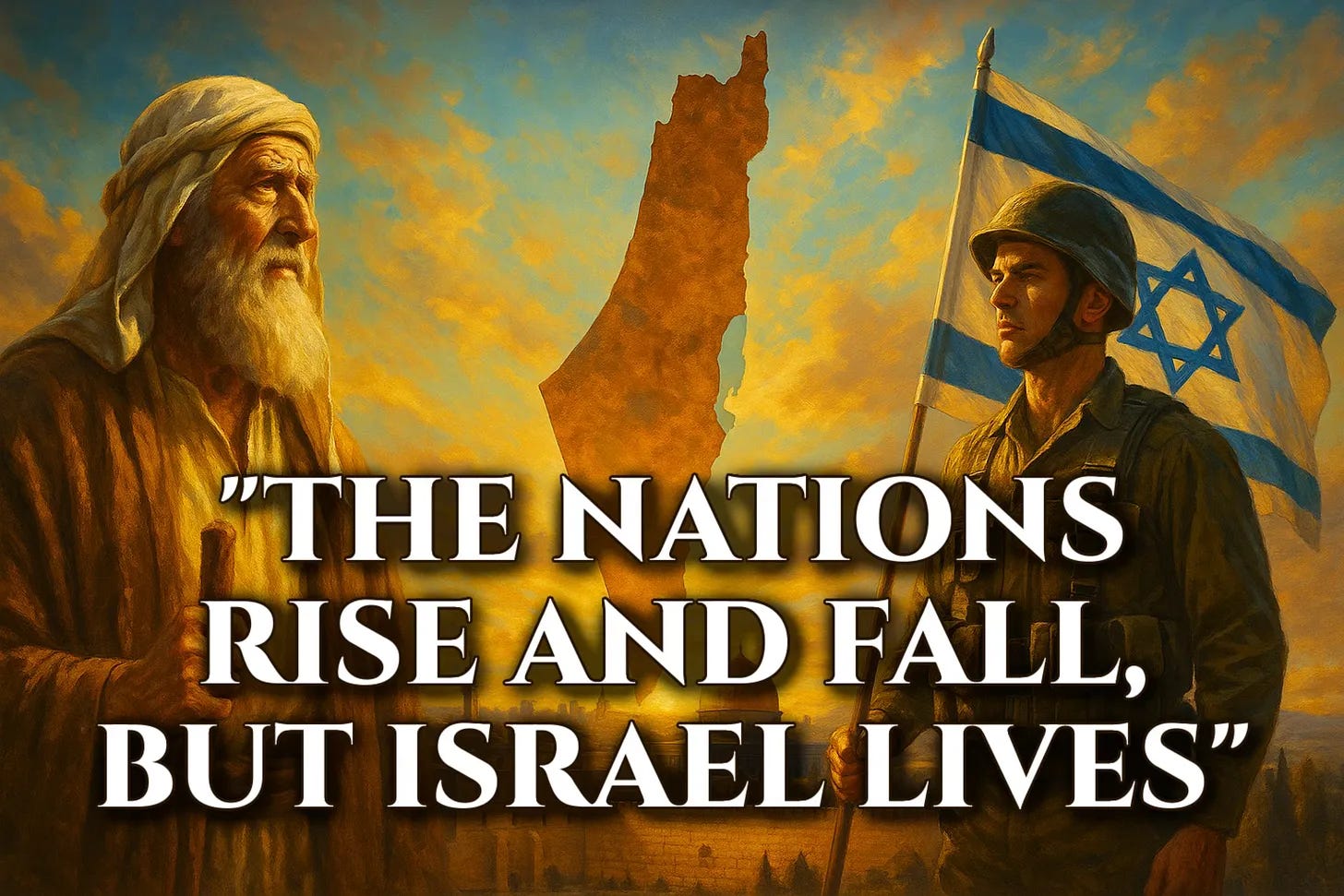
“Nations Rise and Fall, but Israel Lives.”
I have a friend who is a Jew’s Jew.
He was raised a proud Zionist, 23andMe reports his DNA is 98% Ashkenazi, and much of his family lives in the Israeli settlements of the West Bank. His great-grandparents were early Zionists working alongside Theodor Herzl himself. They moved to Palestine in the late 1800s, 60 years before it was renamed Israel. They are buried on the Mount of Olives in the ancient cemeteries.
He’s a Hollywood filmmaker who values his anonymity tremendously —so no, I won’t be giving his name out here. The first couple of times we spoke, he wouldn’t even tell me his real name. After he spoke out against the COVID mandates, the Hollywood crowd punished him professionally. Since then, he’s been tremendously cautious about publicly sharing his views on Israel—especially within that industry. So, he now does it anonymously.
In his early 40s, he began researching the history of Zionism on his own, and everything changed. He is now preparing a biography and podcast titled “Journey to Jesus,” which will cover his slow and steady journey to belief in Jesus Christ as Messiah. He frequently posts about his historical research and personal transformation on his Instagram @zionologist. There, he posts mini-deep dives detailing his Jewish upbringing and the indoctrination he experienced as a youth, including the belief that Jesus was not the son of God.
One of his recent posts caught my attention, because it directly addressed a central Zionist talking point that every American Christian (myself included) has heard a hundred times: “The Nations Rise and Fall, But Israel Lives”. After reading it, I asked him if he would be willing to write an article on the topic for my audience —and I’m so pleased that he agreed. So, without further ado, here are the thoughts of my friend.
“Nations rise and fall, but Israel lives.”
I grew up hearing that phrase not as poetry, but as proof—proof that the Jewish people were the one nation in history that never broke, never disappeared, and never lost their identity. It was one of the most persistent Zionist talking points, and Christian Zionists repeat it just as passionately: every empire that opposed the Jews vanished, yet the Jews remain. I was taught to wear that idea like a badge of honor:
Babylonians? Gone.
Assyrians? Gone.
Egyptians? Gone.
Romans? Gone.
Nazis? Gone.
Only we Jews remain.
It’s a dramatic story—clean, simple, cinematic. And for modern Israel, it’s a very politically useful story. But what I didn’t realize at the time was that this narrative rests on a deeper assumption, one almost never questioned: the belief in an unbroken Jewish continuity—that today’s Jews are the same people, biologically and religiously, as the ancient Israelites. That assumption is the engine behind the sentiment “Israel lives,” and it’s something millions of Christians also believe without ever examining it.
Before I go further, it matters that you understand where I came from. I was raised as a Zionist Jew with generations of grandfathers who were rabbis and early settlers in Palestine in the late 1800s—a pedigree that made the entire story feel unquestionable—and from the very beginning I was taught two absolute truths: that Israel was our God-given homeland, a land promised to us and inherited through our bloodline, and that Jesus is not the Son of God. Not maybe. Not possibly. Absolutely not. Anyone who even suggested otherwise was not just wrong but crazy. Every Jew like myself is indoctrinated from birth to never even consider Jesus as the Son of God, and doing so is treated as a sin.
Jews don’t grow up with Jesus—he isn’t discussed, debated, or explored; he’s simply dismissed before the conversation even starts, a five-letter word you yell when you stub your toe, not someone you could ever believe in. And as I will explain below, this dismissal isn’t random—it’s part of a larger generational indoctrination telling us we are the unbroken children of Israel, chosen, preserved, protected, and therefore incapable of being wrong about anything, especially not Jesus. So it was with that kind of brainwashing—the Jesus taboo, the Zionist certainty, the inherited story of chosenness baked into my identity (before I even knew what identity meant)—that I somehow still managed to open my mind and my heart to the possibility that my parents, and their parents before them, might actually be wrong. Once I allowed myself to even entertain the idea that Jesus could be the Son of God, I began a long, painful, and shocking journey of seeking Him and forming a relationship with God. And as that process unfolded, I was forced to confront the only logical question left: if my people were so wrong about Jesus, what else might they be wrong about?
When I began digging into the history for myself—after decades of being told never to question it—it became difficult to avoid the suspicion that this narrative wasn’t merely inherited, but engineered. The belief in an unbroken Jewish continuity—biological and religious—functions less like history and more like branding. It exists to legitimize modern political claims by imagining a seamless line from Abraham to today.
And I say this as someone whose family lives as illegal settlers in the West Bank settlements, and who once believed every word of it.
The Collapse of the Narrative
The moment you look closely, the whole thing begins to wobble.
Even though I was told that we survived and no one else did, none of that is true. The Assyrians still exist. Egyptians still exist. Romans still exist. Their cultures evolved, their religions shifted, and their empires fell—and the same is true of Judaism. Yet Zionist rhetoric demands that we pretend Jewish identity remained frozen in time while everyone else was either destroyed or mutated beyond recognition.
Part of that narrative claims that these people no longer exist because they were our enemies and tried to destroy us. A very emotional storyline meant to reinforce the idea that we are the true descendants of Israel, that our very existence proves God has chosen us, and that no one should ever oppose us—or else.
It reminds me of the time an evangelical Christian touched my arm because, to him, my survival (the Jews) itself was the miracle, the proof that God exists. In his mind, the fact that I was still here confirmed his faith. I didn’t understand it then, but I do now – he believed that my continued existence, simply because I’m Jewish, validated his theology. This idea runs deep in evangelical Christianity—the belief that the persistence of the Jewish people is proof of divine protection and the fulfillment of God’s promises.
It is problematic for several reasons: It turns people who are Jewish into objects. Treating us as a physical token that validates someone’s theology reduces my identity to a symbol meant to provide their spiritual reassurance. It collapses a complex Jewish history into a prop for Christian faith. It implies ownership over my meaning. It reinforces a dynamic where Jews are instrumentalized —that we exist primarily to fulfill Christian prophecy, which erases Jewish self-definition. And it even diminishes the message of Christ for Jews today—by pushing it into some future apocalyptic scenario instead of seeing it as present and meaningful now.
I hate to say it, but this is dangerous because Christians are easily manipulated. The state of Israel actively leverages this Christian sentimentality, using it as a tool to shape how history and current events are perceived. By appealing to Christians’ theological attachment to the Jewish people, Israel secures support even when its actions stand in direct tension with core Christian values. This emotional and religious loyalty becomes a shield that distorts reality, making it harder for many Christians to see the conflict through a moral, human, or ethical lens rather than through a prophetic one. I’m continually shocked when I see people who claim to follow Jesus endorsing inhumane policies against Palestinians, abandoning both logic and compassion while repeating gross generalizations and biblical misreadings. Much of this comes from Israeli propaganda crafted to manipulate Christians who are unfamiliar with the actual content and context of their own scripture. The result is a community persuaded to defend actions that contradict the very teachings they profess, guided not by the ethics of their faith but by narratives engineered by Jews to exploit their theological naivety. It’s ironic and tragic and dangerous.
These same forces also manipulated me. Growing up, I was told my survival was “proof” that God had preserved us uniquely. Now I can see that this isn’t history. It’s marketing. Let’s first look at the religious side:
A Religion Reborn—But No Longer the Same
After 70 AD, Judaism didn’t “continue.” It collapsed—and was reborn as something very different. The remaining features of the Old Testament’s Israelite religion vanished overnight:
• no Temple
• no sacrifices
• no priesthood
• no geographic center
• no way to keep most Torah commandments
What emerged afterward was not the religion of Moses or even of Jesus’ contemporaries—it was a new system constructed by the Pharisees first, and then the rabbis centuries later:
the Mishnah
the Talmud
rabbinic halakhah
synagogue-based worship
even the yarmulke (do you believe Jesus Christ wore one of these?)
The writing of the Universal Jewish Encyclopedia (1943) is informative here:
“The Jewish religion as it is today traces its descent, without a break, through all the centuries, from the Pharisees. Their leading ideas and methods found expression in a literature of enormous extent. The Talmud is the largest and most important single piece of that literature … and the study of it is essential for any real understanding of Pharisaism.”
Now, most peoples and cultures are understood to evolve, transform, mix, adapt, and become something new over thousands of years. When that happens, we acknowledge it as change. But in the Zionist story, this massive reinvention gets framed as if not much has changed at all, —just a direct line of genetics and religion from ancient Israelites to modern Jews.
If any other group radically changed its identity, narrative, culture, origin story, and relationship to its ancient past as much as modern Jewish/Zionist identity has, people would immediately recognize it as a break — a major discontinuity — rather than a straight, unbroken line of the same people.
But in the Zionist narrative, we just rename reinvention as “miraculous survival.” I was raised not to see the discontinuity. Now it’s obvious it was a complete reconstruction. Modern Zionism, which is the entire justification for Israel and its claim to the land over the people who were already living there when we arrived in the 1900s, relies on both us Jews and you Christians believing that we are the continual, unbroken chain of the same faith and storyline: God’s chosen people wandering through the desert, banished, and now finally “returning” to fulfill some prophecy. It asks everyone to accept that we are literally the people of the Bible, while completely ignoring the fact that for 3,500 years, whatever “Judean” is left inside of us is mixed with other peoples who are just as interesting and historically significant, and mostly not from the Levant at all. Yet, we all still act as if we are the direct descendants of the ancient Israelites, which is neither scientific, truthful, nor even remotely possible. It’s illogical and, at the risk of being offensive, stupid.
Most Christians who support Israel are unfamiliar with the Oral Tradition, the Talmud, or the Kabbalah that shape modern Orthodox Judaism. Many assume that contemporary Jewish belief and practice closely resemble what they read in the Old Testament—but that assumption is profoundly mistaken. These differences are significant and deserve their own careful discussion, which I may save for a future article.
The Genetic Foundation: The Shakiest Pillar
In my experience, Christian Zionists lean hardest on the genetic argument. For many of them, the number one reason for supporting modern Israel is the belief that today’s Jews are direct biological descendants of Abraham.
Ironically, this is the weakest claim of all—and arguably the most aggressively protected.
Consider the massive genetic mixing and intermarriage involved in these events over the centuries—this part is long, but important, if you want to really “get it”.
The Erev Rav —the “mixed multitude” that left Egypt alongside the Israelites (Exodus 12:38)—represents one of the earliest cracks in the idea of an ethnically pure Israel. These were people (mostly Egyptian) who were not Israelites by birth, not part of any ancestral line tracing back to Jacob, yet they attached themselves to the Hebrews and were absorbed into the community. The Torah doesn’t say how many there were, and rabbis have debated it for centuries, but the point is clear: from the very beginning, Israel was a blended people, not a sealed bloodline. The existence of the Erev Rav undermines the notion that the Israelites were genetically unchanged through history, and it shows that outsiders were included in the formation of Israel from the biblical Exodus.
Foreign Conquests: foreign populations were absorbed into Israel after nearly every Old Testament conquest. Each victory brought new groups into the community—people who were not Israelites by ancestry but were folded into the nation—further breaking any idea of a single, continuous bloodline and showing that Israel was always a mixed, evolving population rather than an ethnically sealed one.
The disappearance of the Ten Lost Tribes into surrounding populations is another significant break in any supposed unbroken chain. After the Assyrian conquest in 722 B.C.E., these tribes were deported, scattered, and absorbed into the peoples around them, leaving no traceable line of descent. Their complete assimilation eliminates more than half of ancient Israel as a continuous biological lineage, further dismantling the idea that today’s Jews are anything close to the intact, unchanged people from the Bible.
The Babylonian Exile: After the destruction of the First Temple in 586 B.C.E., the Israelite population was exiled to Babylon and gradually dispersed across the broader Near East. In these new regions, they lived among local peoples, intermarried, absorbed outsiders, and incorporated converts into their communities. Over the centuries that followed, this produced a population whose genetic profile reflects the places they lived and the peoples they mixed with, not a preserved, isolated lineage from ancient Israel. The post–First Temple diaspora was not a sealed ethnic bloodstream carried intact through time—it was a long process of movement, adaptation, and blending that makes any claim to an unbroken biological line from the biblical Israelites historically and genetically impossible.
The Edomites’ absorption into Judea: After the Assyrian and Babylonian upheavals, the Edomites were pushed north into Judean territory. By the late Second Temple period, especially under the Hasmoneans, they were incorporated into the Judean population, many through forced conversion. Over time, they became fully part of the social and religious fabric of Judea. This was not a minor episode—it meant that an entire neighboring people, ethnically distinct from the original Israelites, was folded into what became the Jewish population.
Intermarriage in Persia and the Hellenistic world: After the Babylonian exile, many Judeans remained in Persia, where they lived, traded, and married among surrounding populations for generations. Later, under Alexander and throughout the Hellenistic period, Jewish communities spread across cities from Egypt to Anatolia to Mesopotamia, integrating into cosmopolitan societies where intermarriage and cultural blending were the norm. These centuries of life within Persian and Greek spheres produced communities whose ancestry reflected their environments as much as their Israelite origins. Rather than preserving a closed ethnic line, Jewish identity in these regions became a fusion of local and ancestral influences, underscoring again that the community evolved through mixture, not isolation.
Mass conversions into Judaism occurred throughout antiquity and the early diaspora. From the Hellenistic period through late antiquity, large numbers of Gentiles entered the Jewish community, sometimes individually and sometimes in whole groups. This is part of why Roman writers like Tacitus complained that “the Jewish religion has infected the whole world”—a hostile way of acknowledging how widespread Jewish conversion had become.
Jewish Identity becomes Matrilineal: Around 200 A.D., rabbinic law codified the principle that the mother determines Jewish status, a complete departure from the patrilineal (father based) system of biblical times. Until this time, Jewish lineage, tribal identity, and inheritance followed the father. This shift did not instantly erase all biological continuity, but it did redefine belonging in a way that no longer relied on paternal genealogy. From this point forward, Jewish identity functioned primarily as a legal-religious category shaped by rabbinic authority, rather than by tribal lineage, making any claim to an unbroken biological line from ancient Israelites far less credible.
The history of the Khazar Empire: around the mid-8th century, the Khazar ruling class adopted Judaism which grew among their empire of nearly one million people until they dispersed into Eastern Europe around 1000 A.D. While scholars debate how much this population contributed to later Jewish communities, the fact of their conversion shows that Jewish identity has long expanded through incorporation and absorption, not through an unbroken ethnic bloodline from ancient Israel.
Recent Genome Testing: Genomic testing from the last decade has shown scientifically that Jews today are far less connected to the Levant than the narrative suggests. After more than 3,000 years of movement, exile, conversion, and mixing with other cultures across Europe, North Africa, and Asia, our genomes reflect that history. Meanwhile, Palestinians show some of the most consistent Levantine genetic continuity on earth because they never left and did not undergo the same degree of mixing. In other words, the people portrayed as “foreign” are the ones with the deepest rootedness in the region, and the people claiming an exclusive ancestral right are, genetically, the newcomers. Ironic.
By the time we reach medieval Europe, the picture becomes nearly impossible to trace confidently. The Ashkenazi population explosion from a small founder group suggests a massive influx of non–Middle Eastern DNA. Critics argue that the Ashkenazi genetic profile looks far more European than ancient Near Eastern.
Is all of this uncomfortable for Zionists? Apparently so.
Each of these events creates significant problems for their claims of a clean genetic descent from Abraham. They reveal that Zionism and its accompanying myths can only survive among people who have never examined the history, science, or scripture behind them. These narratives were crafted and repeated to persuade uneducated Christians and Jews to believe something that has little grounding in genetics, archaeology, or the Bible—only in prejudice, wishful thinking, and inherited ignorance.
There’s one more talking point on this that need to be addressed.
The Myth of the 70 AD Jewish Expulsion: The familiar story is that the Jews were exiled en masse in 70 AD, wandered the earth for two thousand years, and are now “returning home” as of 1948. Yet, this not supported by history or archaeology. Yes, Rome destroyed the Temple, and yes, most Jews fled Jerusalem, but they did not flee the Roman Province of Judea. Most of the Jewish population remained in the region around Jerusalem. Over the centuries, these Jews gradually became Christians under the Byzantine Empire and later Muslims under Arab rule—forming a substantial portion of the genetic ancestry of today’s Palestinians. Perhaps I should repeat this: a substantial portion of today’s Palestinians descend from the very people (Jews, Samaritans, Idumeans) who lived in the land in the time of Christ.
The Name Game
This leads to an uncomfortable conclusion—one I never imagined I would reach: what Jews have preserved most consistently over thousands of years is not our genetics, not religious practice, and not even cultural continuity—it is the name.
The name “Jew” has endured, but the reality behind that name has changed dramatically over time. That isn’t unusual, —many people reinvent their identities as history unfolds. The real issue isn’t the change itself, but the insistence that Jewish identity has remained essentially the same since the days of Abraham.
Myth as Political Tool
Once I became a Christian and stepped outside the Zionist worldview I had been raised in, something became painfully clear: the continuity narrative makes sense once you recognize its function. It provides:
ancient title to land
theological legitimacy
a sense of chosenness
an emotional shield against criticism
and, most importantly, a recruitment tool for Christian Zionist support
And make no mistake—Zionism depends heavily on Christian naivety and enthusiasm. Without it, their political engine would sputter out.
But myths built for political usefulness should not be mistaken for historical truth.
The claim that Jews uniquely survive while all their enemies vanish is not simply wrong—it appears intentionally simplified to the point of flat-out lying. Judaism changed radically. Genetics are deeply uncertain. Cultural continuity is selective at best. And the modern state whose legitimacy rests on these very claims seems remarkably unwilling to let science settle the matter.
I don’t fault my family for believing what we were taught. We were indoctrinated in it from birth, and questioning it felt like betrayal. My grandparents did not have the privilege of education or the ability to think beyond their survival.
But if the continuity narrative were as unassailable as advertised, it wouldn’t need to be protected so aggressively—or propped up by Christians who have never been encouraged to look beyond our slogans.
It is no crime for a “people” to reinvent themselves or genetically mix. The real problem is demanding the world pretend all this never happened, and shaming anyone who asks questions.
—May God bless you all, and Happy Thanksgiving! —Zionologist
Further Reading: Who Was Cyrus Scofield?
Cyrus Scofield: Scoundrel or Scholar?
This is the third article of a five-part series covering these topics:


"And make no mistake—Zionism depends heavily on Christian naivety and enthusiasm. Without it, their political engine would sputter out."
Thank you Jeremy for making this available, it is excellent. I'll be restacking with a note sometime today. Let's keep the Faith and keep spreading the word of truth. Happy Thanksgiving to you & yours.
Outstanding post from someone with firsthand experience in the Jewish ideology. Lots of clarity here!